• Home
  • ♦ About
  • ♦ Maps
  • ♦ Plants
  • ♦ The Dream
  • ♦ Book
  • ♦ Resources

Radical Botany

Restoring the connection between native plants and humans

Feeds:
Posts
Comments

Creating a foraging tool box- day pack must-haves

November 20, 2010 by Ellen O'Shea

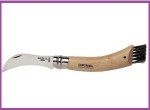
Opinel hooked-bill knife

When I go out into the forest and wilderness areas I go prepared to meet up with extrordinary wild life, unknown weather and terrain and beautiful environments. I am prepared for my own safety too.  Here is what I carry.  My day pack includes the following:

1. A good pair of locking hand pruners and a pair of long handled pruners as well
2. Opinel hooked bill knife – I have some special tools I use when harvesting plants. I carry an Opinel hooked bill knife that closes into the handle. It has a brush on the other end of it that I use to brush off dirt and other debris. This knife is really good for harvesting mushrooms and roots.
3. A triple hand lens magnifier – this hand lens magnifies to 5x, 10x and 15x and will close to become 30x. This lens helps me to identify plants by their tissue and small parts.
4. Swiss army knife – provides lots of gadgets.
5. My camera – I love to take pictures of plants. I use these pictures to create my illustrations and to share on my website.
6. Drinking water
7. Rubber boots and a rain slicker for the winter, and washable shoes for the summer and an extra pair of warm socks.
8. A good hat to keep the sun off my head
9. Collection bags.
10. First aid kit that includes matches wrapped in plastic
11. A good compass
12. Binoculars
13. A high energy snack
14. Good maps – forest service maps are the best
15. A whistle – to blow if I get lost or run into a animal I do not want to be near.
16. I sometimes also have a bell to attach to my pack if I think there might be bears around.

17. I wear layered clothes in case I come upon a change in weather

18. My cell phone with the 911 GPS turned on. If I ever get lost, people will be able to find me hopefully.

Here is a link to a great website that has most of these tools available

http://www.compleatnaturalist.com/mall/folding_magnifiers.htm

Share this:

  • Click to share on Facebook (Opens in new window) Facebook
  • Click to share on X (Opens in new window) X
  • Click to email a link to a friend (Opens in new window) Email
  • Click to print (Opens in new window) Print
  • Click to share on Reddit (Opens in new window) Reddit
  • Click to share on LinkedIn (Opens in new window) LinkedIn
Like Loading...

Related

Posted in Cascadian Bioregion, Ethnobotany | Tagged Cascadia Bioregion, Connection to Nature, foraging tools, native plant foraging |

  • Archives

  • Blog Stats

    • 208,972 hits
  • Archive of posts

    November 2010
    M T W T F S S
    1234567
    891011121314
    15161718192021
    22232425262728
    2930  
    « Oct   Dec »
  • Green lady

    Unknown's avatarGreen Lady - Ellen

  • Radical Botany pages

    • ♦ About
    • ♦ Definitions
    • ♦ First Nations of Cascadia – tribes
    • ♦ Friends and Sponsors of Radical Botany
    • ♦ Most Important Native Plants in Cascadia
    • ♦ Permaculture
    • ♦ Plant Teachers: Botanists, Ethnobotanists and Naturalists
    • ♦ Plants
    • ♦ Resources
    • ♦ Maps
    • ♦ Book
    • ♦ The Dream
    • Ellen O'Shea's avatar
  • Categories

    • British Columbia Native Plants
    • Cascadian Bioregion
    • Conifers in the Cascadian Bioregion
    • Ethnobotany
    • Flower physiology
    • Fungi and mushrooms
    • Geology of Cascadia
    • Native plants and wildlife survival
    • Northern California Native Plants
    • Oregon native plants
    • Permaculture
    • Plant identification schemes
    • plant roots
    • postaweek2011
    • Uncategorized
    • Washington Native plants
    • What is a native plant?
  • 2012 native plant education 2013 Native plant education botany botany lessons British Columbia British Columbia Native plants Cascades Cascadia Bioregion Cascadian bio-region native plants Cascadian bioregion Cascadian bioregion healing plants Chanterelles Coast range mountians Connection to Nature Cooking wild mushrooms Decidious native trees early flowering native plants environmental preservation Ethnobotany Flower identification schemes Food foraging tools GMO plant protection Indian plum.Osoberry leaf morphology meristem cells Missoula floods Mistletoe Native fungi of the Cascadian bioregion Native plant education native plant foraging Native Plant identification Native plant pollinators Native plant preservation native plant root systems Native plants Native plant seed Native plant seed genetics Naturalists Northern California Northern California native plants Oregon Oregon Grape Oregon Native plants plant cell physiology plant cell structure plant evolution plant identification Plant identification Stinging Nettle Plant leaf plant roots as food and medicine Plant Wisdom postaweek2011 Recipe ring-of-fire root foraging stomata in plants Terence McKenna Washington Washington Native plants What is a native Plant? yule greens
  • Tweets

    Tweets by treesareme
  • Enter your email address to follow this blog and receive notifications of new posts by email.

    Join 111 other subscribers
  • Meta

    • Create account
    • Log in
    • Entries feed
    • Comments feed
    • WordPress.com
  • Follow on Facebook Radical Botany

    Follow on Facebook Radical Botany

Blog at WordPress.com.

WPThemes.


  • Reblog
  • Subscribe Subscribed
    • Radical Botany
    • Join 111 other subscribers
    • Already have a WordPress.com account? Log in now.
    • Radical Botany
    • Subscribe Subscribed
    • Sign up
    • Log in
    • Copy shortlink
    • Report this content
    • View post in Reader
    • Manage subscriptions
    • Collapse this bar
 

Loading Comments...
 

    %d