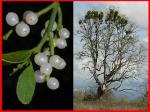
Mistletoe and the Garry Oak Tree
At this time of the year in many western and European countries you will see mistletoe put up as a holiday decoration. Is it a native plant in the Cascadian bioregion? Yes. It is called a hemi-parasitic plant. That is it lives in a symbiotic relationship with other plants and is also considered a parasite to trees.
There are many myths about the power of mistletoe to bring humans together. Thus it is the custom of many to place mistletoe above a door and encouraging people to kiss. In one custom men have the privilege of kissing a woman under it- plucking each time a berry from the stem. When all the berries are all plucked the privilege ceases.
But mistletoe has other important uses to the forest ecosystem.
There are actually three types of mistletoe located in our bioregion. Two live in conifers. The Douglas dwarf mistletoe (Arceuthobium douglasii) lives in the Douglas fir. And the Western dwarf mistletoe (arceuthobium campylopodum) is most often found in the Western Hemlock but can also be found on pine, juniper, and other conifer trees. And last, the most popular type of mistletoe is found in the Garry or White Oak located in oak savannahs throughout the region.
Garry Oak mistletoe (Phoradendro flavescens) is the type popular during our Solstice/Christmas season. It was long thought to be purely parasitic and might even kill the host tree. Now, after years of study the plant is actually known to be part of a unique ecosystem that encouraged oak tree propagation.
For instance the name Mistletoe is attributed to old German and old English language and means twig dung. Because birds eat the seeds and the seeds are deposited in their dung and fertilized. The same birds eat other cone seeds, and acorn’s and carries them to other sites to be planted and fertilized. The acorn of the Oak is picked up by squirrels that also come to the oak for the berries of the mistletoe.
The mistletoe found in conifers is very unique. It causes the tree to produced odd shaped branches that grow closely together in a thatch. This is called a “witches broom”. This type of mistletoe is often overlooked because it occurs high up in the conifer. This thatch makes a wonderful nesting site for some very vulnerable birds in our region such as the Northern Spotted Owl and the Marbled Murrelet. A wide range of animals depend on mistletoe for food, consuming leaves, young shoots, transferring pollen between plants and dispersing it’s seeds.
Medicinal aspects of Mistletoe
First peoples and people who live in Western and Northern Europe used Mistletoe to cure aliments of the circulatory and respiratory system. A tincture or infusion was prepared and the solution was used sparingly. The overuse of the plant parts can cause gastric problems that can lead to diarrhea or worse. It is not uncommon for a teacher to tell children that the berries are poisonous.
According to the book “A Modern Herbal” by Mrs. M Grieve, mistletoe was traditionally used as an effective treatment for convulsive disorders such as epilepsy. Mistletoe has also been used as an experimental treatment for cancer, though scientific evidence of its effectiveness as a cancer cure is limited. Medicinal forms of mistletoe include teas, tinctures and injections. Mistletoe extracts that are depleted of lectins, one of the toxins in mistletoe, are less likely to produce adverse reactions.
IS Mistletoe poisonous?
Mistletoe can make cats and dogs and children quite ill if ingested in high enough doses. It is best to keep mistletoe up high while decorating. Young children may think the berries are eatable. But it is like most powerful healing plants, a very useful plant if used correctly.
In modern times mistletoe has been studied to see if it can treat cancer. It was found to stimulate the immune system increasing the amount of white cells that attack the malignant cells. Much more investigation needs to be done to understand how this happens. And a homeopathic does of mistletoe was formulated by Rudolph Steiner as he believed that mistletoe diluted (homeopathic) could treat a faltering of the body’s spiritual defenses. Again it is best to contact a qualified herbalist, naturopath or physician.
For more about native plants used in celebrations check out this excellent article on Wikipedia called “Festive Ecology”
 Green Lady - Ellen
 Radical Botany