BIG LEAF MAPLE (Acer macrophyllum)
Trees are sanctuaries. Whoever knows how to speak to them, whoever knows how to listen to them, can learn the truth. They do not preach learning and precepts, they preach, undeterred by particulars, the ancient law of life. – Hermann Hesse, Trees: reflections and poems

Dear ones,
I have struggled for weeks for the words to express my love of the trees. My last attempt while teaching about conifers was to create graphs, with just the fine points, of how to possibly experience conifers. I spent hours trying to choose just a few words to express the cones, needles, wildlife, habitat, healing qualities and ethnobotany of each tree. I wanted you to carry the graph into the forest and touch each tree.
But somehow it felt empty. I did not have enough space to express the soul of the tree. The one thing above all else is that I want you to know that the trees are alive! They are alive in a way that humans are alive. And we humans are decimating them.
Now, I want teach you about 12 deciduous trees that live in the Cascadian bio-region. There are far more than 12 of course. But these 12 are my friends. I will again teach in essay form- as a story teller. That is what Great Spirit who loves us all wants me to do. Tell you the story of the tree and how we are related. I will attempt to convey what the trees have taught me, rather than what science has collected about the trees. I want you to fall in love with the trees. I want you to go outside and embrace the trees as you would a lover. I want you to cherish the trees so much that you will not allow them to be decimated. I will teach you the indigenous name as well as the common English language and Latin name of each tree so that you can learn how humans related to the tree for thousands of years.
So let us begin
BIG LEAF MAPLE (Acer macrophyllum)
The Name- before the Europeans came and renamed everything, this tree was called many things. It was a protector, a habitat creator, a source of food,shelter, medicine and tools. It was a wood used to make canoe paddles and ceremonial masks and rattles. It was a sacred being in the forest; it was much revered. Here are a few of the names that the First Peoples of Cascadia used to identify this tree.
sqəlelŋəxʷ = Salish =Any large Tree
K’u’lawi = Chehalis
Cuk’ums = Cowlitz
Stsla’act = Klallam
K!amali’tc = Lummi
K!o’luwe = Skokomish
Two years ago I lived in an older apartment complex near Oregon State University in Corvallis, Oregon where there was a still-standing grove of Big Leaf Maple trees. The large trees had been on the land for over 200 years and were part of the original farmstead that graced the area 100 years ago. A developer bought the property in 2009, tore down the trees in 20122, and built a shambles of cheap “student” apartments. My heart was broken. I had known these trees since my childhood. I moved away and took my potted garden with me. Much to my delight many of my potted native plants and herbs pots began to sprout Big Leaf maples. The trees near my apartment had dispersed their “Samara” or winged seeds to my pots and I unknowingly took them away from the slaughter. Today they still travel with me as I search for land to settle on. They are getting quite tall and I may have to find a safe haven for them in a nearby forest. It does my heart good to know that I took the offspring of my childhood friends to a new life. I hope that I can also find a place to plant myself near these young ones and watch them grow.
THE BIG LEAF MAPLE – A Mother Tree
These trees are magnificent large trees that can grow over 100 feet tall and branch out another 100 feet as well. The tree offers shelter to diverse wildflowers that need shade and moisture. Wherever you find this forest of Big Leaf Maple you will find Bleeding hearts, ferns, Larkspur, Trillium, Salmon berry, Thimble berry, Indian plum, and Elder berry. Vine maple and other native shrubs are found growing under this tree. The branches often harbor a completely new eco-system of ferns, mosses, lichen and herbs. Numerous birds nest in the branches and the knots and cave-like holes found in its bark.
The Big Leaf Maple is the “mother tree” of the forest. Much like the Western Red Cedar in the conifer forest, the Big Leaf Maple attracts the conditions, the plants and fungi that create a healthy viable eco-system.
I used to climb these big trees. I know these trees. The trees can live hundreds of years. Their outstretched large limbs made a wonderful place to hang a tree cocoon (canvas tent hung in a tree). The wildlife attracted to the tree was phenomenal. One of my favorite things to do in the spring was to visit the blooming flower of Big Leaf Maple. I stood under the tree and felt the light breeze of the thousands and thousands of bees and other pollinators visiting the tree for nectar. There was so much pollen distribution that it fell downward and peppered the ground with a light yellow dusting. I came away covered in pollen. It was such an invigorating experience. I often built fairy altars under the tree in thanks giving for its great beauty and vitality. White Oak (Quercus garryanna) grew on the edge of the forest. Red cedar and other conifers speckled the forest. Squirrels, deer, blue jays and wild doves moved throughout the forest. Wild rabbits and raccoons ran along the well-traveled animal trails.
THE RACEME – The flower of the Bigleaf Maple
The Raceme- is a pendulum-like flower stalk that hangs down from a short stalk attached to an early spring leaf bud. It is unbranched and it’s yellowish to light green flowers open up to an array of wild and domesticated bees and other pollinators. The Bigleaf maple begins to flower at about 20 years of age. Insects and bees pollinate the tree and produce about 1000 pollen grains per flower. The flower pollen and other secretions are quite sweet. The nectar-rich flowers were eaten raw in the spring by the Sannich First peoples. It was said to be an over-all spring tonic and was highly nutritious. The sticky gum of the spring bud was used as a hair tonic.
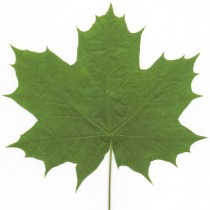 THE LEAF
It has the largest leaves of any maple, typically 15–30 centimeters (0.49–0.98 ft) across, with five deeply incised palmate lobes. They are dark green above and lighter green below. The leaf will turn yellow in the fall.
The large leaves were used under layers of food while cooking on an earthen oven. The leaves were used to cover food cooking in pits. The leaf stalk has a milky juice when cut. This is the sticky gum used in hair tonic.
THE SEED- SAMARA
My favorite wild seed – called a “whirly-gig” by children and more playful adults. The fruit is a paired winged seed called a samara. Each seed is approximately 1–1.5 centimeters (0.39–0.59 in) in diameter with a 4–5 centimeters (1.6–2.0 in) wing. Wings help to disperse the seeds throughout the forest. The whirly-seeds or double-winged samara, as well as spring’s leaf-buds, are a major food source for squirrels, birds, & other wildlife. The First Peoples of the Salish Coast ate the young sprouted seeds as food.
 THE BARK
In the more humid parts of its range, as in the Olympic National Park, its bark is covered with epiphytic moss and fern species. The species that grow upon the branch of the Bigleaf maple can form canopy roots deep into the adhering mosses. The mosses are often so deep they create their own soil and their own ecosystem. The bark of the tree is green when young and grows grey-brown and ridged after a few years.
HABITAT
This species of maple is found in dry to moist sites, often with Douglas-fir. Found in low to middle elevations in its range. The trees are found along riverbanks and in somewhat early spring damp areas. The trees will begin to rot if they stand too long in flooded areas, but they are often found in native rainforests.
ETHNOBOTANY
In many coast Salish languages, its name actually means “paddle tree” because the people are able to carve paddles out of its wood due to its great size. Some other helpful tools fashioned from the Big-Leaf Maple include dishes, spoons, hairpins, combs, and scouring pads.The inner bark was eaten in small quantity as it was constipating. The inner bark was also used to make baskets, rope and whisks for whipping soopolalie berries. Some First Peoples ate young maple shoots raw, and also boiled and ate the sprouts when they were about 3 cm tall. The leaves, like Skunk Cabbage leaves, were used as a base for drying berries. The large leaves were also used for storing food during the winter or burned in steaming pits to add flavor to food.
The wood was used for spindle whorls and various other implements such as combs, fish/duck spearheads, and fish clubs. The ends of branches and strips of bark were used in basketry. The wood was used to make masks and rattles used in ceremony.
The sap was boiled and made into sweet maple syrup and sugar by some First Nations.
POLLINATORS ATTRACTED TO BIGLEAF MAPLE
The Bigleaf maple is an important early blooming tree. The tree blooms in March and is essential food for many wild bees, honey bees and other pollinators that are now threatened because of habitat and plant loss.
Here is a short list of wild bees that need this tree for food and habitat:
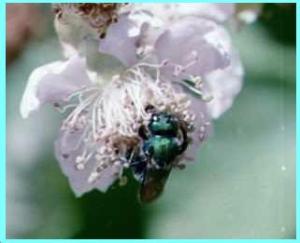 Solitary bees – Osmia aglaia – O. aglaia are metallic blue, green or rust/bronze in color. They nest in tunnels in wood about 3/8 – 1/4 inches in diameter. They are active as adults in late spring, while Rubus is in bloom

Osmia lignaria- mason orchard bee
Blue Orchard bees – Osmia lignaria, in the Portland area and in WashingtonState are more attracted to Big leaf Maple, Acer macrophyllum
And of course the honey bee-
A short video looking at the structure and habitat of the Big Leaf Maple
References
- Gunther, Erna (1973) revised edition Ethnobotany of Western Washington, University of Washington Press, Seattle and London. pp. 39
- Moerman, Daniel E.(1998) Native American Ethnobotany, Timber Press, Portland and London, pp.38
- Pallardy, Stephen G. (2008) Third Edition, Physiology of Woody Plants, Academic Press, Burlington, MA – Elsiver Inc. pp. 90
- Pojar & McKinnon, (1994) Plants of the Pacific Northwest Coast, Washington, Oregon, British Columbia & Alaska, Lone Pine Publishing, Vancouver, British Columbia
 Green Lady - Ellen
 Radical Botany