Feeds:
Posts
Comments

Archive for the ‘Cascadian Bioregion’ Category

Shooting stars at Mt. Shasta

“The day man experienced the consciousness that made him feel separate and superior to the other forms of life, at that moment he began sowing the seeds of his own destruction.” (U. G. Krishnamurti) 

I am on a journey, a quest to save native plants from destruction by our mechanized minds and world.

I want to try and save what is left of the natural world. I think it is important. I want there to be a beautiful, healthy, safe world for my children, my grandchildren and  for seven generations after me.  There are so many beautiful parts of God’s creation worth saving. It all needs to be saved.  The web of life fits together like a puzzle. When one part goes missing, the rest is weakened. I choose to try and save native plants.

We have been going down this path for some time. Most humans are oblivious to what is happening to our planet, or they choose to close their eyes and try to ignore it.  I choose to teach about native plants because they choose me and I would not want to live on this planet if all the plants were gone. In fact, none of us could.

All parts of the web of life are worth saving.  The polar bears, the whales, the brown pelican, the hummingbirds, the great trees and the great forests are all worth saving.  The water and the air and the earth are needed for the web of life to survive. They are all worth saving.  Each of us who understands the importance and immediacy of saving the planet will need to choose where to focus. I choose native plants.

I am almost old and I have been on this journey for some time. I have been blessed to have good teachers.  When I was a child living near the forest I only knew a few names of the plants.  I spent years exploring the forest before I found a good teacher to tell me about the plants. The plants were always there for me, healing me, and helping me through loss and in times of wonder.

I walked through the forest speaking to the birds, the tree,  and the other plants. I built a nest in a tall Red cedar tree and climbed the great oak. I carried a pad and pencil with me into the forest and sat for hours watching the forest, observing the plants and wildlife. I made note of how the petal of a flower connected to the stem and how the stem connected to the root. I drew pictures of what other plants might be growing nearby so I could remember how to find it again.  I was amazed at the ingenuity that plants develop in order to survive.  I observed that the natural world is a place of connections.  Nothing is alone. I saw how the native plant connected to all species including humans.

I had teachers when I was a child who told me stories about the plants: grandma and my wonderful father.  Very little was taught to me in grade school or high school about native plants. I remember being told not to eat anything in the forest because it was probably poisonous.  In fact as a women I was only allowed to take one science class in high school.  What I learned later from history books was that for thousands of years women were the keepers of plant knowledge.  As Black Elk said: the world has turned upside down.

I combed over books. I looked for pictures and I looked for thehistory of the plants.  I never took a botany class in college although I had many mind-numbing science classes.  I did not want to memorize factoids, I wanted to understand and know the plants. I did not want my childhood wonder to be destroyed by long intense lectures and pressure to “get the grade”.  And yet I have learned that it is helpful to learn about plant kinship.

So I asked myself: how could I teach others about native plants?  What would I want them to know?  How could I get other humans to understand that native plants are not on this planet just for our pleasure?  Would I teach you one plant at a time?  Or would I teach you all about “keying” plants using the “binomial nomenclaturemethod of plant identification.  I surmised that people learn differently.  So I will be teaching all three methods, keying, “binomial nomenclature” and grandma’s way.

Grandma

Who was grandma?  She was an older woman who lived across the fields and forest from me when I was a child.  She loved the natural world. She was patient and kind and a very good teacher. I discovered her one day in a field of Queen Anne’s lace collecting the tiny purple flower found in center the plant. She was going to make dye for fiber baskets. We struck up a friendship. She told me many stories about the plants and I am forever grateful that she taught me about native plants.

If I was to try to teach you about native plants using grandma’s method I would take you on a walk in the forest.  I would ask you to bring a notebook and a pencil. I would find a place that attracted me. We would sit amongst the plants and we would be quiet and observant. I would ask you to write what you are observing. I would ask you to make notes about the weather, the time of year, the condition of earth: is it wet or dry? Does it have a smell?  I would wait until a particular plant came to me attention. And then I would ask you to observe it as I told you a story about this plant. It might be a story about its structure or connection with the forest. Or it might be a story about how to use the plant for food, medicine or how it might feed and attract wildlife.  If it is edible, I would ask you to taste it. I would ask you to find its flower and draw a picture of it.  I would ask you to write about how it connects to the rest of the forest.  I would try to tell you a story about how the First People’s used this plant. I would hope that this story would help you remember it. This is my way of learning and teaching.

Shooting Star (Dodecatheon jeffreyi)

 Over the years I have carried my water colors into the wild places and tried to capture the beauty of plants in their own spaces.  I rarely pick wild flowers. I have attached a painting I did of Shooting stars in a meadow just below Mt. Shasta in Northern California.  The variety is called Tall Mountain Shooting Star (Dodecatheon jeffreyi).  This plant is so beautiful.  Pojar and McKinnon in their book “Plants of the Pacific Northwest Coast” describe the special relationship between Shooting stars and bumblebees. The Shooting star they say provides a good example of “buzz pollination”. Pollen is shed into the stamen tubes of the flower. The sound waves set up by the buzzing of the bumblebee dislodges the pollen and makes it available to the bee. A member of the primrose family (Primulaceae) the plant is most often found in moist meadows. The First peoples of the Willamette Valley, Okanagan, and Yurok tribes mashed the flowers and used the stain to dye fibers and wood.

There – I just taught you a little about this plant. Where to find it, what it was used for and how it interacts with wildlife. That is the way I like to teach. But there are others and I cannot always be with you.

So until next week – See you in the deep woods…

Next time:  Kinship and the “Keying” of  plants – teaching you to be self sufficient in your learning.

References:

Pojar & McKinnon, (1994) Plants of the Pacific Northwest Coast, Washington, Oregon, British Columbia & Alaska, Lone Pine Publishing, Vancouver, British Columbia

Turner, Nancy J. (1979) Plants in British Columbia Indian Technology, British Columbia Provincial Museum, Victoria, British Columbia, Canada
Read Full Post »

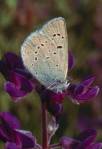
Fenders Blue Butterfly and the Kincaid Lupine

I attended a wonderful talk at the Straub Environmental Center is Salem, Oregon last night.  The speaker Gail Gredler an instructor at our local community college spoke about creating native plant gardens. She answered a lot of questions I had about what is a native plant and why are they important to humans and to the planet.

What is a native plant?

First, according to Gail a native plant can be described as plants growing before European settlements started about 200 years ago. Other sources I found also describe them this way: “A native (indigenous) species is one that occurs in a particular region, ecosystem, and habitat without direct or indirect human actions” (Kartesz and  Morse 1997; Richards 1998

Gredler explained that trying to say what is native and what is not is getting harder because some plant specialists are cloning and messing with the DNA of native plants to create “nativars”.  These mad scientists (my judgment) are creating these bio-modified cloned plants so they can patent the plant and make money on each sale of the plant or its seeds.  Bio-modification is not made with ecosystem health in mind so we don’t know if there will be detrimental effects.  People are beginning to sell the look-alikes as natives and so it is important to find a native plant nursery that is registered.  (See resource list at end of this article).  Insects may or may not recognize the plant chemicals of these “nativars”.  Some research on bio-modified corn and other grain crops are showing that insects will not pollinate the crops because the plant chemicals are toxic to the pollinator. The bio-modified grains are causing issues with human and animal health also.

Insects need native plants to survive.  We need insects alive so that our food and medicine and utility plants can be pollinated and fertilized. Without insects and native plants our biome will experience an ecological collapse.

 Ke Chung Kim an entomologist with Penn State University writes in his book “Biodiversity, conservation and inventory: why insects matter”, that insects and anthropods have existed for more than 400 million years and after surviving the Permian and Cretaceous mass extinctions, arthropods have been the most successful of all living things and along with other invertebrates constitute more than three-quarters essential for human food production, and maintaining rain forests, savannahs and other important components of global water storage in ecosystems.

 Without insects we would experience complete eco-system collapse. Native plants are the only food that many pollinator insects will consume. Without native plants, many insects such as the Fender Blue butterfly, the Franklin’s Bumble Bee (Bombus franklini) and Mason bees (Osmia cascadica) will become extinct.  Bringing native plants back into our environment is essential to the survival of humans, fauna and flora. Once the insects are gone, then will fall the birds, squirrels, foxes, rabbits, deer, and other fauna. The food chain will collapse.

According to Gredler 90% of insects depend on native plants for food. Local insects evolved with native plants and are attracted to particular leaf chemicals.  The leaf chemical allows the insect such as the Fender Blue butterfly and pollinators to find food. Only 10% of insects are generalist feeders.

Here are 7 reasons on why native plants are important according to Gredler.

  1. Resource conservation:  Native plants do not need a lot of extra water. They are drought resistant. Most native plants that would grow in Oregon and (Washington, British Columbia) valleys do not need extra water in the summer time. They need well adapted to our dry summers.
  2. Save on the use of fertilizers and pesticides:  Native plants do not need pesticides. They are already acclimated to insect populations and can take care of themselves, thank you.  Fertilizers are applied sparingly.  Having plants grow in correct soil types is more helpful.
  3. Insects need them to survive. As already mentioned: 90% of insects depend on native plants for their survival. 37% of animal species eat herbivorous insects.
  4. Native plants in landscapes will stop the desertification of Cascadia.
  5. Habitat fragmentation is a hazard to wildlife.  Bringing natives back will stop the ecosystem collapse. Native plants provide food, water, and habitat for wildlife.
  6. Plants are the only thing on the planet that can harvest the sun’s energy and create their own food.
  7. Native plants are not necessarily aggressive and can be out done by non-natives. They will need our help to come back.  We need to stop planting aggressive non-natives like the Butterfly plant.

Here are few more from other sources:

8.  Native plants are important to human health. The vast array of natural chemicals is already the basis for ~25% of all U.S. prescriptions, ranging from aspirin (bark of willow tree) to taxol (bark of pacific yew tree).  These plant based medications easily break down in our ecosystems unlike pharmaceutical synthetic hormones and drugs. Use native plants for healing and stop the chemical soup poisoning of our world.

9. Native plant heritage: plants were used for almost everything that humans needed to survive. Think what the world would be like if we stopped producing toxic plastic “stuff” and went back to living simply with few things, essentials made from plants: clothes, homes (not from trees but from fast growing plant fiber and earth such as in Cob buildings).  Paper not made from our forests but from fast growing plant fibers. Humans lived with this technology for hundreds of thousands of years.  We may have to adjust to new ways of living to survive.

10. Native plants can be used to restore our land.  They easily adapt to harsh conditions and have been used in the repair of streams, meadows, savannahs, forests, and other fragile landscapes.

According to Gredler since the 1840’s over 80 million acres have been taken out of native landscapes.  Landscapes have been paved over, planted in non native turf grass and tilled for non native crops.  Gredler called this process the “desertification of Oregon”.  I call this process the desertification of Cascadia because this destruction of the bio-region is happening everywhere.

According to my other source Kartz and Morse, although only about 737 native plant species are protected by the Endangered Species Act, it is estimated that nearly 25 percent of the 20,000 native plant species in North America are at risk of extinction. It is becoming generally recognized that in order to preserve individual species, their plant communities must be preserved. This includes the preservation of native plants that are not yet in danger of extinction, but still play an important role in native ecosystems.

Native plant species provide the keystone elements for ecosystem restoration. Native plants help to increase the local population of native plant species, providing numerous benefits. There are specific associations of mycorrhizae with plants, invertebrates with woody debris, pollinators with flowers, and birds with structural habitat that can only be rebuilt by planting native plants.

 We need your help.  Begin today to tear out the turf and aggressive non-natives and plant your yards to become a native plant repository and sanctuary.

Resources:

Where to find a list of reputable native plant nurseries in cascadia

1. Online PDF booklet of native plant nurseries in Oregon and Washington

http://extension.oregonstate.edu/yamhill/sites/default/files/wholesale_np_nurseries.pdf

2. Sources of Pacific Northwest native plants – a online Pdf booklet

http://extension.oregonstate.edu/yamhill/sites/default/files/sources_for_native_plants.pdf

3. The plight of the Fenders Blue Butterfly and its relationship to Kincaid’s Lupine

http://www.xerces.org/2010/12/10/saving-the-fenders-blue-butterfly/

If you would like to learn more about the relationship between insects and humans, animals and plants, check out the Xerces Society website at:    http://www.xerces.org

References

Kartesz, John, North Carolina Botanical Garden, and Larry Morse, The Nature Conservancy. 1997. Personal communication

Kim, Ke Chung (1994) Biodiversity and Conservation, Volume 2, Number 3, 191-214, DOI: 10.1007/BF00056668, Center for Biodiversity Research, The Pennsylvania State University. http://www.springerlink.com/content/q465056vr1t45u67/

Read Full Post »


Artic Lupine

Salem, Oregon

Amateur Naturalist Series -Landscaping with Natives, Gail Gredler

January 13, Thursday, 7-8:30 pm Program: Creating Native Plant Gardens. Gail Gredler, Instructor of Horticulture at Chemeketa Community College, will explain how to create native plant gardens and landscapes. She will highlight the benefits of gardening with native plants and discuss which plants to use to create a haven for birds, pollinators, and other wildlife. The class costs $5 and is open to the public and is co-sponsored by Willamette Valley Chapter of the Native Plant Societyand the Straub Environmental Learning Center. Location: 1320 A St. NE, next to Olinger Pool, near North Salem High. Registration is required. To register, call John Savage at 503-391-4145. All classes are held at the Straub Environmental Learning Center at 7:00 p.m.  Call or email Alexandra at 503-391-4145 or fselc@fselc.org to register.   Website:  http://www.fselc.org/programs.html

Eugene, Oregon             January 10, Monday, 7:30 pm

Meeting: Bruce Newhouse presents “Delights, Myths and Legends of Native Plant Gardening.” Can midwinter exploration of gardening delights, myths and legends bring spring here sooner? Let’s try it and see! Join us for this presentation on creating “deep gardening” goals that can make a garden both good looking and purposeful. Is there really a difference between planting native or non-native plants in a home garden? Do native Plants have special care needs? Native plants are not easy to find for sale, so where can I get them? These and other questions will be addressed in this show. You can create a small ark of native biodiversity in your yard if you are willing to include native bees, butterflies and birds as part of your inner circle of friends. Sharing between like-minded gardeners will be encouraged during this event. If you would like to read a good primer, try “Bringing Nature Home,” by Douglas Tallamy. Can spring be far behind?

Location: EWEB Training Rm., 500 E. 4th Ave., Eugene. For more info call 541-343-2364.

 Ashland, Oregon

Wildflowers (many of which are endemic and very rare) begin to bloom in the lower altitudes in February and March. The Native Plant Society leads walks throughout the Rogue Valley on Saturday mornings (See www.npsoregon.org)

Tundra Swans

RIDGEFIELD, WASHINGTON

Ridgefield National Wildlife refuge – Annual return of the trumpeter and Tundra Swans also large repository of Wapato and other native water plants.  http://ridgefieldbirds.com/TheRefuge/Birds/ridgefield_NWR_tundra_swan.html

Seattle, Washington – Native Plant Society of Washington

Seattle Chapter     –    Saturday, January 8th

Tradition Lake Plateau, led by Nelson Salisbury and Louise Kulzer
Come join our Chapter Botanist, Nelson Salisbury, and Field Trip Chair, Louise Kulzer, for a bit tamer New Year romp on the Tradition Lake Plateau. It’s not New Year’s Day, but it’ll still get the year off to a great plant start. We’ll peruse the extensive plant list created by Fred and Ann Weinmann and see how many of the choicest mid-elevation plants we can find. Pacific willow, the most upland of the willows, mature ninebark, cherry and a conifer of great girth (was it a hemlock?) are some of the highlights I remember from a past field trip. Wintering waterfowl should be on the lake, Douglas squirrel and woodpeckers are also to be expected. Trip length can range from 3-5 miles, depending on the group’s desires, with moderate elevation gain.Note:  The gate to the parking area is closed, so we’ll meet at the gate and hike the .4 miles in.  Dress warmly! 
Date & Time Saturday, Jan. 8, 2011; 9 AM
Location Meet at the parking area by the trailhead at 9:00 AM. Take I-90 past Issaquah to Exit 20, then turn right on the frontage road to the gate. Note:  The gate to the parking area is closed, so we’ll meet at the gate and hike the .4 miles in. 
Contact Contact Nelson at 206-372-4255 or nelson@earthcorps.org to sign up.
Bring Bring water and a lunch and dress for the weather.


Native Plant Identification Workshop

Join Nelson Salisbury, Chapter Botanist, in a free plant identification workshop that is offered before each Chapter meeting at 5:30 PM in CUH, Main Hall.  While the workshop is oriented primarily toward beginners, anyone who wants to work on improving keying skills or their familiarity with the northwest flora is welcome.  Feel free to bring samples of unknown plants in for identification.  We will have plenty of material and tools if you come empty-handed.

Tri-cities – Washington

Koma Kulshan

Winter Twigs and BudsMeet at 9 AM at North Chuckanut Trailhead. We will decide then and there on route, depending on weather and interest.  We might hike four or five miles, but should be back by 3:00.  This winter walk will emphasize identification of deciduous trees and shrubs based on their twigs and buds (copies of a key will be provided).  There is a diverse assortment of native and non-native plants along the upland trails and along the Chuckanut beachfront. Bring lunch, and dress for the weather, including boots for muddy trails. 
Date & Time Saturday, Jan. 29, 2011; 9 AM
Location Meet at 9:00 AM at North Chuckanut Trailhead (the parking lot on Chuckanut Drive south of Old Samish Road and before California Street).
Contact Contact Allan Richardson at 733-5477 or boghill@earthlink.net to confirm. 

http://www.wnps.org/chapter_info/chapter_trips.html

British Columbia

Vancouver, British Columbia

Thursday January 6, 2011

Presentation: Fabulous fungi of Haida Gwaii
Paul Kroeger 
Until recently, very little was known about the kinds of fungi found on Haida Gwaii. Why should we care? Because fungi play incredibly important roles in ecosystems. Without fungi, we wouldn’t have the rich native plant communities that we have in BC.
Paul Kroeger is one of a team of mycological specialists who has been studying fungi in Haida Gwaii since 2003. He’ll talk about some of the species found there – including some rare species – and about the role of fungi in maintaining the health of our forests and other plant communities.It all happens at 7 p.m in the Cedar Room at VanDusen Botanical Garden, at 37th and Oak in Vancouver.Coming soon:
February 3: Edible plants of Coastal BC with Andy McKinnon
March 3: Flora of White Lake with Terry McIntosh
April 7: Pink Mountain Revisited with Ron Long 

 http://www.npsbc.org/Education/education.htm

Read Full Post »

In 2011 I will be sharing with you why you need to respect and bring native plants into your life.  I will be doing this in a pragmatic way. First I am going to take up the post-a-week challenge made by WordPress and will be updating my blog weekly. 

 I will share with you why it is so imperative that humans stop destroying their natural environment.  I will share with you the science behind why native plants are so important.  I will teach you to identify native plants so that you can start visiting them in the wild places and start bringing them back into your health and wellness regimes, your yards, your cities and biomes.

I will be listing more activities found in Cascadia (the area from British Columbia to Northern California) that will help you connect with the both native plants and those who can teach you what you need to know.

You can help me.

Tell me what is going on in your area of the world that inspires others to protect native plants.  Share inspired comments to this website (skillshare).  Tell others about this website and this project.

I will be learning more about the technology offered by WordPress and available on this website.  I promise to learn how to tweet, digg, RSS, etc. I know I can do it, I know I can do it…

I will be publishing my book as an e-book during 2011.  It will include illustrations and watercolors that I have completed of native plants, plant identification charts, maps, and other useful information.  This book has 18 chapters.  Here is preview of the chapters.

Table of Contents

Introduction: finding our way back, reconnecting with the plant world. 1

Chapter 1. Plant Community, human community (White Oak) 5

Chapter 2. Learning the lay of the land (Oregon Grape) 11

Chapter 3. How to identify and “key” native plants (Miner’s lettuce) 19

Chapter 4. Building shelters from plants (Willow) 27

Chapter 5. Growing your own fibers: Grasses, sedges, tules and fiber plants (Cat-tail) 29

Chapter 6. Seeds and wild plants. What is valuable?. 31

Chapter 7. The great harvest (Wapato) 33

Chapter 8. Digging in the dirt- exploring earthworms and mycelium.. 35

Chapter 9. Using native plants as medicine (Pacific Ninebarks) 37

Chapter 10. Spring plants in Cascadia (Nettles and the potherb) 39

Chapter 11. Stalking the wild plant – Tools, geography, maps (Horsetail) 41

Chapter 12. Fermenting the bounty (Red and Blue Elderberry) 43

Chapter 13. Bringing the native plant and pollinators home. 45

Chapter 14. Twenty important native plants you need to know.. 46

Chapter 15.Place where the spirit dwells- First Nations- the ethnobotany of native plants  47

Chapter 16. Generational Injustice (St. John’s Wort) 49

Chapter 17. Bringing Native plants back into our mechanized world (Cats Claw) 53

Chapter 18.  Resources and Tools: books, gear, online resources. 57

WordPress will not allow me to publish the ebook or link to the ebook on this website so I am looking for other avenues to let you know how to support the Radical Botany project.  I will find a way to let others purchase the book and support this project to educate others about native plants .  I will continue to update this blog weekly and continue to teach what I know and what I am learning. 

  I am looking into starting a non-profit education project.  I hope to locate to a more rural area in Cascadia where I can have a greenhouse and native plant nursery and school.  I want to live next to the forest.

So those are my resolutions for 2011.  I hope that you will contribute in a positive way.

See you in the deep woods – Let us begin…

Happy New Year! 

Read Full Post »

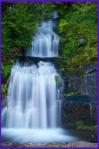
Today I went for a walk in the Cascadian coast range.  I was looking for greens to make a yule wreath for my front door.  It is a ritual I do each year to thank the earth for giving me sustance.  I do not cut the greens but instead I walk in the forest and whatever appears before me on the ground, I forage.  Today as I walked along a came upon a beautiful waterfall, bursting at the seams after heavy rains.  The wild birds twittered around me as they jumped from branch to branch.  I was gifted with many beautiful plants.  Recent heavy winds had pruned the gifted plants.  They lay on the ground before my feet.  Whatever is before me, is what I am to use. 

My wreath will consist of long boughs of a red cedar, pollen cones intact.  Shorter fuller boughs of the douglas fir, salal, Oregon grape, and pearly everlasting.  I also picked up some cones of the douglas fir.  It was a wonderful day.  I was quite high up in the coast range so the rain started to turn to snow and I hiked through the woods. The mountain kept asking me “when will you live here?”  “Someday” is my answer.

I do not cut down Christmas trees anymore.  I make my wreath of earth gifted plants and I decorate a large Jade Plant that lives in my home with small ornaments of dried flowers, cones, stones, shells.  It all works for me. Others have other traditions. It all works.

On December 22 the days will start being longer.  Winter will begin to turn to spring.  Thank you earth.  Thank you sky.

Read Full Post »

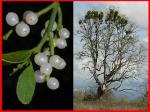
Mistletoe and the Garry Oak Tree

At this time of the year in many western and European countries you will see mistletoe put up as a holiday decoration.  Is it a native plant in the Cascadian bioregion?  Yes.  It is called a hemi-parasitic plant.  That is it lives in a symbiotic relationship with other plants and is also considered a parasite to trees.

There are many myths about the power of mistletoe to bring humans together.  Thus it is the custom of many to place mistletoe above a door and encouraging people to kiss.  In one custom men have the privilege of kissing a woman under it- plucking each time a berry from the stem.  When all the berries are all plucked the privilege ceases.

But mistletoe has other important uses to the forest ecosystem.

There are actually three types of mistletoe located in our bioregion. Two live in conifers.  The Douglas dwarf mistletoe (Arceuthobium douglasii) lives in the Douglas fir.  And the Western dwarf mistletoe (arceuthobium campylopodum) is most often found in the Western Hemlock but can also be found on pine, juniper, and other conifer trees.  And last, the most popular type of mistletoe is found in the Garry or White Oak located in oak savannahs throughout the region.

Garry Oak mistletoe (Phoradendro flavescens) is the type popular during our Solstice/Christmas season.  It was long thought to be purely parasitic and might even kill the host tree.  Now, after years of study the plant is actually known to be part of a unique ecosystem that encouraged oak tree propagation.

For instance the name Mistletoe is attributed to old German and old English language and means twig dung.  Because birds eat the seeds and the seeds are deposited in their dung and fertilized. The same birds eat other cone seeds, and acorn’s and carries them to other sites to be planted and fertilized.   The acorn of the Oak is picked up by squirrels that also come to the oak for the berries of the mistletoe.

The mistletoe found in conifers is very unique.  It causes the tree to produced odd shaped branches that grow closely together in a thatch.  This is called a “witches broom”. This type of mistletoe is often overlooked because it occurs high up in the conifer.  This thatch makes a wonderful nesting site for some very vulnerable birds in our region such as the Northern Spotted Owl and the Marbled Murrelet.  A wide range of animals depend on mistletoe for food, consuming leaves, young shoots, transferring pollen between plants and dispersing it’s seeds.

Medicinal aspects of Mistletoe

First peoples and people who live in Western and Northern Europe used Mistletoe to cure aliments of the circulatory and respiratory system.  A tincture or infusion was prepared and the solution was used sparingly.  The overuse of the plant parts can cause gastric problems that can lead to diarrhea or worse. It is not uncommon for a teacher to tell children that the berries are poisonous.

According to the book “A Modern Herbal” by Mrs. M Grieve, mistletoe was traditionally used as an effective treatment for convulsive disorders such as epilepsy. Mistletoe has also been used as an experimental treatment for cancer, though scientific evidence of its effectiveness as a cancer cure is limited. Medicinal forms of mistletoe include teas, tinctures and injections. Mistletoe extracts that are depleted of lectins, one of the toxins in mistletoe, are less likely to produce adverse reactions.

IS Mistletoe poisonous?

Mistletoe can make cats and dogs and children quite ill if ingested in high enough doses. It is best to keep mistletoe up high while decorating.  Young children may think the berries are eatable.  But it is like most powerful healing plants, a very useful plant if used correctly.

In modern times mistletoe has been studied to see if it can treat cancer. It was found to stimulate the immune system increasing the amount of white cells that attack the malignant cells. Much more investigation needs to be done to understand how this happens.  And a homeopathic does of mistletoe was formulated by Rudolph Steiner as he believed that mistletoe diluted (homeopathic) could treat a faltering of the body’s spiritual defenses.    Again it is best to contact a qualified herbalist, naturopath or physician. 

For more about native plants used in celebrations check out this excellent article on Wikipedia called “Festive Ecology

Read Full Post »

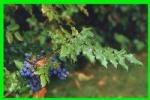
Oregon Grape

Oregon grape is one of my favorite plants. It is known by many healers as the goldenseal (Hydrastis canadensis) of the West Coast. I have used it to heal many ailments, including those of my cat and other animals. I’ve also used it to make dye for wool and basketry and to eat the berries for nutrition. All parts of the plant are valuable and powerful healers.  It is a plant to be respected!

Oregon grape lives in a tight, healthy tribal community, a perfect mirror of how a healthy human community once lived. It is very important to honor that community when harvesting this plant. 

Go to the Oregon grape community with right intent.  If you are a commercial “wild crafter” trying to make your quota, stay away!  Oregon grape is a powerful plant.

Harvesting the Oregon grape

Habitat: The Oregon grape lives throughout the western part of North America, in mountainous areas on wooded slopes that are below 7000 feet. Oregon grape plants exist in a specialized ecological community. Oregon grape roots and thrives under especially powerful healing trees like red cedar, sequoia, and Sitka spruce. 

Intention: Your intention should be first to learn the lesson the plant wants to teach you. Second, you should intend to use this medicinal plant wisely. Third, you should be respectful in harvesting, and fourth, you should always leave thankful for the medicine.

I guess I could also say that what I just shared with you should be the way to harvest all plants.

Selection: Never harvest the largest central plant.  This is the mother plant, a vigorous plant whose roots reach out to the whole community. Sometimes if the community is quite large, there will be more than one mother plant.  Think of these plants as tribal leaders. The largest plants in the community attract certain bacteria to the community soil, and they draw insects, other plant chemicals, and earth worms and other tunneling creatures that feed the community.

The largest plants are not always the ones that have the most color or the strongest medicine.  Be respectful–the plants to harvest are the smaller ones. Oregon grape is best harvested in August or September when it is full of berries.  It is OK if there are a few flowers on the plant.

Find the Oregon grape community. Look out in front of you, and you will see a plant whose leaves are especially green. The berries on the plant will be full and deep blue; the flowers, if still blooming, will be brighter than the others in the community. This plant will be in the outer circle of the community, not too near an animal or human path.

Root Harvest: When harvesting the root, slightly uncover the soil around the plant root. Do not pull up the plant!  Find a side root, not the tap root.  (The tap root is central to keeping the plant alive.  It is the largest central root that provides nourishment for the plant.) Use a sharp knife that has been cleaned with an organic seed oil like olive oil or sunflower seed oil.  Keep this knife clean between harvests.   Always place an offering to the Oregon grape next to the plant.  I carry tobacco, Mayan corn, or sunflower seeds that I grow especially for offerings.  Be thankful.  A root harvest is a wonderful gift from the Earth. I talk to the plant when I am harvesting.  I tell the plant that I will use its root wisely.  I talk about the healing that I need to do and ask for wisdom about the best way to proceed.  I sit with my journal and write down what comes to me about the plant.

Using the Roots

The root of the Oregon grape contains strong medicine. The bright yellow root, a color caused by an alkaloid called berberine, can also be used for dye. Berberine, the most studied of the alkaloids, has been shown to possess fungicidal and antibacterial activities as well as resistance against protozoa such as Giardia lamblia, Trichomonas vaginalis, and Entamoeba histolytica. This is a very powerful healing plant and practitioners should consult a plant healer to learn to make the tinctures and infusions.

The Oregon grape root is the most commonly used part of the plant. Recent studies indicate that M. aquifolium contains a specific multidrug resistance pump inhibitor (MDR Inhibitor) named 5’methoxyhydnocarpin (5’MHC) which works to decrease bacterial resistance to antibiotics and antibacterial agents.1

Oregon grape root is used almost exactly like other Berberis and goldenseal species, as an alterative (an agent that gradually changes a condition), antibiotic, diuretic, laxative, and tonic. It is commonly used internally to detoxify the blood in an effort to cure skin problems, and occasionally it is used as a treatment for rheumatism. In homeopathy, Oregon grape is used as a tincture for skin diseases, like acne, eczema, herpes, and psoriasis.

Using the Berries

Many of the First Peoples of Western Cascadia used the berries for food.  There was no difference between food and medicine for these indigenous peoples.  They recognized that whatever you put into your body caused healing or disease. There was no such thing as recreational food.  Native peoples used a few berries mixed with Salal or some other sweet berries as a staple dried food in the winter months.  Today the berries are made into jelly (mixed with other sweet berries or fruit). The berries are also used medicinally to cleanse the liver and gall bladder and to treat eye problems.  Don’t take all the berries on a plant; leave some for the birds and wildlife.

Using the Stems

The stems of Oregon grape were used by native peoples as a dye.  Stems were shredded with Oregon grape root and soaked, and a bright yellow dye could be extracted from the mixture.  I use sharp clippers to cut branches from a plant. When harvesting the berries and the stems, take a small amount from each plant.

Read Full Post »

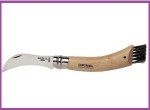
Opinel hooked-bill knife

When I go out into the forest and wilderness areas I go prepared to meet up with extrordinary wild life, unknown weather and terrain and beautiful environments. I am prepared for my own safety too.  Here is what I carry.  My day pack includes the following:

1. A good pair of locking hand pruners and a pair of long handled pruners as well
2. Opinel hooked bill knife – I have some special tools I use when harvesting plants. I carry an Opinel hooked bill knife that closes into the handle. It has a brush on the other end of it that I use to brush off dirt and other debris. This knife is really good for harvesting mushrooms and roots.
3. A triple hand lens magnifier – this hand lens magnifies to 5x, 10x and 15x and will close to become 30x. This lens helps me to identify plants by their tissue and small parts.
4. Swiss army knife – provides lots of gadgets.
5. My camera – I love to take pictures of plants. I use these pictures to create my illustrations and to share on my website.
6. Drinking water
7. Rubber boots and a rain slicker for the winter, and washable shoes for the summer and an extra pair of warm socks.
8. A good hat to keep the sun off my head
9. Collection bags.
10. First aid kit that includes matches wrapped in plastic
11. A good compass
12. Binoculars
13. A high energy snack
14. Good maps – forest service maps are the best
15. A whistle – to blow if I get lost or run into a animal I do not want to be near.
16. I sometimes also have a bell to attach to my pack if I think there might be bears around.

17. I wear layered clothes in case I come upon a change in weather

18. My cell phone with the 911 GPS turned on. If I ever get lost, people will be able to find me hopefully.

Here is a link to a great website that has most of these tools available

http://www.compleatnaturalist.com/mall/folding_magnifiers.htm

Read Full Post »


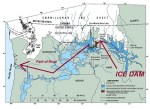
Glacial Lake Missoula

Before you search Cascadia for the great healing plants, you should understand the lay of the land. What formed this amazing place?  What kind of soils and geology will you encounter as you hike through its forests, valleys, and high deserts? 


Why should you learn the geology of a place?  Why understand the lay of the land? The benefits are manifold:

          You will know where to find the plant communities

          You will not get lost in the woods or the mountains or the desert; you will be able to find your way from any point on the land

          You will know how to find food, water, and shelter when you need it

          You will see wonderful things and will not be afraid to wander in paradise. You will remain open to adventure, and you will encounter unusual plants within their communities

Where else on Earth could you live near an ocean, active volcanoes, coniferous rain forests, high deserts, marsh lands, sea estuaries, fertile valleys, high mountain glaciers, and so much more?  The Cascadian bioregion is a place of earth, water, and fire.  It is a place whose geology is new, old, and ever forming.

Plant life here is diverse and often unique. Many plants have adapted to wide swaths of this land; others are to be found in areas so small that they are in danger of disappearing off of the Earth.

What Geological Forces Shaped the Cascadian Bioregion?

Cascadia stretches from British Columbia to northern California to the north and south and includes Idaho and Western Montana to the East. On the big scale, it is being formed by the constant tension between two geological plates that are part of the Earth’s crust.  One plate stretches out into the Pacific Ocean moving eastward and is being pushed up into the land mass (Coast Range Mountains) toward the Cascade Mountains.  The other plate is moving westward and reaches deep into the hot, molten earth which is constantly forming the Cascade Mountains.  Between the two mountain ranges are valleys shaped by yet more geological forces.  This process is so dynamic that it is being created right in front of our eyes. This mountain range–valley–mountain range scene only covers one-third of the states of Oregon, Washington and Northern California.  The other two-thirds–now this is going east as the crow flies–is mostly high desert. There are some other mountain ranges to the east of the Cascades like the Wallowa and the Steens, but the plant life there is very different than the western third of Cascadia.  The eastern part of these states is a place of pine, hemlock, and juniper forests. People in other parts of the world seem to have the idea that Cascadia is all about Douglas firs, the Pacific Ocean, and the fertile farm valleys.  However, the area is diverse in plants and animal life, geology and hydrology.

Valley Floods

In Cascadia the western valleys were formed by old and new geological forces.  The valleys were formed somewhat by old rivers meandering through the soil levels.  Another amazing force was the periodic catastrophic floods.  These were floods in which 300 foot walls of water careened down valleys and river gorges, carving out new geologic formations and leaving behind vast layers of huge boulders, rock, minerals, and sand and gravel pits.  The First Peoples of Cascadia had many myths about the floods.  One interesting book that provides examples of these myths was written by Ella Clark called “Indian Legends of the Pacific Northwest”.  Clark reports that many of the creation myths of people of the region included stories about wildlife escaping the floods that renewed the area and then the animals and trees and plants helping the humans to survive and thrive. In these myths the animals help the Creator plan the world by using floods to shape the region. Here is link to a website that stores many indigenous people’s creation myths.  http://www.indigenouspeople.net/legend.htm

The Missoula Wash – the great floods of the region

If you go up on Mary’s Peak, located in the central part of western Oregon, you can look out over vast parts of the Willamette Valley.  You will see a place shaped mostly by the meandering Willamette River.  However, every once in a while you will see mounds–big, round mounds.  For a long time it was thought that these mounds were formed by Native Americans depositing shells or dirt for burial grounds.   In the 1920s scientists started to investigate the possibility that a great flood had occurred in Cascadia.  The flood, called the Missoula Wash or Missoula Flood, occurred thousands of years ago when a great glacial lake near Missoula, Montana, burst its seams.   Imagine a wall of water 300 hundred feet tall surging down the Columbia Gorge and then into the Willamette Valley.  What a sight that must have been! This was not one event: the glacial lake burst about every 50 years and made for some really exciting times in the valleys of Oregon and Washington. These floods deposited sand, gravel, and other mineral deposits throughout the area, and left large boulders throughout the Willamette Valley. 

After each ice dam rupture, the waters of the lake would rush down through the Columbia River gorge of eastern Washington and the Willamette Valley of Western Oregon. It took 40 to 50 years for restoration of these areas. Geologists estimate that floods occurred approximately 40 times over a 2,000 year period roughly 15,000 to 13,000 years ago.

Up until about 100 years ago, many of the valley areas of western Washington and Oregon were a series of lakes and marshes.  Anglo pioneers drained and filled in many of the lakes and marshes to create the farmland that is in the valleys today.  Many valuable plant communities were driven to the edges of the valley, and some plants can no longer be found in the area.  Camas, a staple food for native peoples, once graced the old marshlands.  There are few of these plants to be found in the marshes and sloughs of Willamette Valley (including Portland) today. Now many of the area’s camas plants live in very polluted waters. Native peoples did not live year-round in these valleys, because they could have caught malaria or tuberculosis.  They did, however, build seasonal shelters from plants, so they could fish and collect valuable foods and healing plants.

The Coast Range Mountains

The Coast Range Mountains extend from British Columbia to northern California.  The mountains are old and worn away by erosion and time.  They were formed by forces that pushed land up off the ocean floor, and it is not uncommon to find sea fossils and other sea sediments in this mountain range.  Up until about 75 years ago, the area was a vast and beautiful rain forest.  Much of the Coast Range has been clear-cut in the Cascadian bioregion. Many wonderful plants have been lost, because the fragile soils have been washed away by erosion and lack of a supportive ecosystem. Because the soils are old, they lack certain essential minerals needed by plant communities. Many humans who live in these mountains often have bad teeth because of lack of minerals.  Farmers and gardeners must add minerals (glacial rock is a wonderful source of these minerals) to help plants grow.  In the past the forests were kept healthy because of migrating salmon, steelhead, and other sea-run fish.  The spawning fish would swim up the streams, die in the river bed, and provide excellent fertilizer for the forest floor.  The sea -run fish helped plants to thrive.  It is getting harder and harder to find certain very valuable plants that once flourished in the Coast Range, because the fish are disappearing from the streams.

The Coast Range Mountains are not particularly tall compared to the Cascades Mountains, but there are a few larger mountains spattered along the Coast Range. And their height is important, because the taller Coast Range Mountains provide habitat for plants normally found only in the western slopes of the Cascades.

Some of the more important Coast Range Mountains habitats  are found at  Mount Olympus on the Olympic Peninsula, Mary’s Peak (Tamanawis) near Corvallis, Oregon, Mount Ashland near Ashland, Oregon, the Siskiyou Mountains and the Klamath Mountains in southern Oregon,  and the Trinity Mountains of northern California.

The lost world

One of the most important and unique places in the Cascadian Coast Range is the Kalmiopsis Wilderness Area.  There is no other place in Cascadia where you find more diverse, unusual, and important healing plants.  Walking through this area will make you feel like you are visiting another planet.  Even the soil is different. Much of the soil is of the Serpentine type. The hard bluish rock soil often found near perioditite rocks organizes itself in layers and is rich in heavy metals such as magnesium, iron, chromium and nickel, which in high amounts, can be toxic to most plants.  Plants and animals found in this area of Southern Oregon are often unique to the area.  And many of the trees and plants in the area need periodic fire to complete their life cycles.

The Cascade Mountains

Highly volcanic and very alive, these mountains provide much drama for both plants and humans. The Cascades are part of the Pacific Ring-of-Fire, the volcanoes and associated mountains that circle the Pacific Ocean. All of the known historic eruptions in the contiguous United States have been from Cascade volcanoesThey are large and snowcapped in the winter, and some still support glaciers.  In the summer melting glaciers and snowmelt create the beautiful lakes, rivers and marshes of the region. The snowmelt is also the main source for drinking water in the region. The wilderness around these mountains provides a safe harbor for the diverse plant communities that have offered food, clothing, healing, and shelter to humans and other creatures for thousands of years. Each mountain has its own energy but shares with other Cascade mountains similar soils, weather, and plant communities. 

This essay was originally written for Portland Indymedia as a skillshare on January 27, 2008. 

Read Full Post »

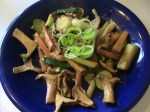
After spending a wet morning in the Oregon Coast range mountains collecting chanterelle mushrooms I decided to sauté up some delicious “roots and shrooms”.

This week I went to a local farmers market and purchased some late season zucchini and some beautiful multicolored carrots.  I also purchased some fresh leeks.  I decided to mix them with my newly found Chanterelles and create a beautiful feast.

The trick to eating mushrooms is to never eat them raw.  Mushrooms have amazing nutritional and medicinal qualities that can only be released through cooking.  Cook all mushrooms at least 15 minutes over low heat.  Here is my recipe for cooking wild Chanterelles.

What you will need:

Two tablespoons olive oil

Two large gloves fresh garlic – sliced thinly

Sliced leeks to taste (I used about ¼ cup)

1 cup sliced fresh carrots

½ cup sliced fresh zucchini

8 to 9 medium to large Chanterelle mushrooms

¼ cup Tamari

Herbs to taste (powered basil, sage, black pepper, and coriander) ¼ teaspoon each

Use a large flat frying pan or a Wok. Slowly sauté two tablespoons of olive oil and two large gloves of fresh garlic on very low heat.  Cook 5 minutes.  Add two tablespoons of tamari, ¼ teaspoon each powered sage, basil, black pepper, and coriander. (You can substitute the herbs you like to use here).  You have now created a wonderful broth to cook your veggies and mushrooms in. Arrange the vegetables and mushrooms on the bottom of a flat surface of the pan in the sauce you have just prepared.

Sauté for at least 15 minutes until the carrots are soft enough to eat. Turn the mixture over a couple of times to make sure all sides are fully cooked. I covered the pan with a lid during this time.  ENJOY!

Read Full Post »

« Newer Posts - Older Posts »