Feeds:
Posts
Comments

Oregon Grape

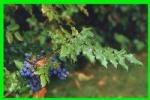
Oregon grape is one of my favorite plants. It is known by many healers as the goldenseal (Hydrastis canadensis) of the West Coast. I have used it to heal many ailments, including those of my cat and other animals. I’ve also used it to make dye for wool and basketry and to eat the berries for nutrition. All parts of the plant are valuable and powerful healers.  It is a plant to be respected!

Oregon grape lives in a tight, healthy tribal community, a perfect mirror of how a healthy human community once lived. It is very important to honor that community when harvesting this plant. 

Go to the Oregon grape community with right intent.  If you are a commercial “wild crafter” trying to make your quota, stay away!  Oregon grape is a powerful plant.

Harvesting the Oregon grape

Habitat: The Oregon grape lives throughout the western part of North America, in mountainous areas on wooded slopes that are below 7000 feet. Oregon grape plants exist in a specialized ecological community. Oregon grape roots and thrives under especially powerful healing trees like red cedar, sequoia, and Sitka spruce. 

Intention: Your intention should be first to learn the lesson the plant wants to teach you. Second, you should intend to use this medicinal plant wisely. Third, you should be respectful in harvesting, and fourth, you should always leave thankful for the medicine.

I guess I could also say that what I just shared with you should be the way to harvest all plants.

Selection: Never harvest the largest central plant.  This is the mother plant, a vigorous plant whose roots reach out to the whole community. Sometimes if the community is quite large, there will be more than one mother plant.  Think of these plants as tribal leaders. The largest plants in the community attract certain bacteria to the community soil, and they draw insects, other plant chemicals, and earth worms and other tunneling creatures that feed the community.

The largest plants are not always the ones that have the most color or the strongest medicine.  Be respectful–the plants to harvest are the smaller ones. Oregon grape is best harvested in August or September when it is full of berries.  It is OK if there are a few flowers on the plant.

Find the Oregon grape community. Look out in front of you, and you will see a plant whose leaves are especially green. The berries on the plant will be full and deep blue; the flowers, if still blooming, will be brighter than the others in the community. This plant will be in the outer circle of the community, not too near an animal or human path.

Root Harvest: When harvesting the root, slightly uncover the soil around the plant root. Do not pull up the plant!  Find a side root, not the tap root.  (The tap root is central to keeping the plant alive.  It is the largest central root that provides nourishment for the plant.) Use a sharp knife that has been cleaned with an organic seed oil like olive oil or sunflower seed oil.  Keep this knife clean between harvests.   Always place an offering to the Oregon grape next to the plant.  I carry tobacco, Mayan corn, or sunflower seeds that I grow especially for offerings.  Be thankful.  A root harvest is a wonderful gift from the Earth. I talk to the plant when I am harvesting.  I tell the plant that I will use its root wisely.  I talk about the healing that I need to do and ask for wisdom about the best way to proceed.  I sit with my journal and write down what comes to me about the plant.

Using the Roots

The root of the Oregon grape contains strong medicine. The bright yellow root, a color caused by an alkaloid called berberine, can also be used for dye. Berberine, the most studied of the alkaloids, has been shown to possess fungicidal and antibacterial activities as well as resistance against protozoa such as Giardia lamblia, Trichomonas vaginalis, and Entamoeba histolytica. This is a very powerful healing plant and practitioners should consult a plant healer to learn to make the tinctures and infusions.

The Oregon grape root is the most commonly used part of the plant. Recent studies indicate that M. aquifolium contains a specific multidrug resistance pump inhibitor (MDR Inhibitor) named 5’methoxyhydnocarpin (5’MHC) which works to decrease bacterial resistance to antibiotics and antibacterial agents.1

Oregon grape root is used almost exactly like other Berberis and goldenseal species, as an alterative (an agent that gradually changes a condition), antibiotic, diuretic, laxative, and tonic. It is commonly used internally to detoxify the blood in an effort to cure skin problems, and occasionally it is used as a treatment for rheumatism. In homeopathy, Oregon grape is used as a tincture for skin diseases, like acne, eczema, herpes, and psoriasis.

Using the Berries

Many of the First Peoples of Western Cascadia used the berries for food.  There was no difference between food and medicine for these indigenous peoples.  They recognized that whatever you put into your body caused healing or disease. There was no such thing as recreational food.  Native peoples used a few berries mixed with Salal or some other sweet berries as a staple dried food in the winter months.  Today the berries are made into jelly (mixed with other sweet berries or fruit). The berries are also used medicinally to cleanse the liver and gall bladder and to treat eye problems.  Don’t take all the berries on a plant; leave some for the birds and wildlife.

Using the Stems

The stems of Oregon grape were used by native peoples as a dye.  Stems were shredded with Oregon grape root and soaked, and a bright yellow dye could be extracted from the mixture.  I use sharp clippers to cut branches from a plant. When harvesting the berries and the stems, take a small amount from each plant.
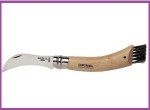
Opinel hooked-bill knife

When I go out into the forest and wilderness areas I go prepared to meet up with extrordinary wild life, unknown weather and terrain and beautiful environments. I am prepared for my own safety too.  Here is what I carry.  My day pack includes the following:

1. A good pair of locking hand pruners and a pair of long handled pruners as well
2. Opinel hooked bill knife – I have some special tools I use when harvesting plants. I carry an Opinel hooked bill knife that closes into the handle. It has a brush on the other end of it that I use to brush off dirt and other debris. This knife is really good for harvesting mushrooms and roots.
3. A triple hand lens magnifier – this hand lens magnifies to 5x, 10x and 15x and will close to become 30x. This lens helps me to identify plants by their tissue and small parts.
4. Swiss army knife – provides lots of gadgets.
5. My camera – I love to take pictures of plants. I use these pictures to create my illustrations and to share on my website.
6. Drinking water
7. Rubber boots and a rain slicker for the winter, and washable shoes for the summer and an extra pair of warm socks.
8. A good hat to keep the sun off my head
9. Collection bags.
10. First aid kit that includes matches wrapped in plastic
11. A good compass
12. Binoculars
13. A high energy snack
14. Good maps – forest service maps are the best
15. A whistle – to blow if I get lost or run into a animal I do not want to be near.
16. I sometimes also have a bell to attach to my pack if I think there might be bears around.

17. I wear layered clothes in case I come upon a change in weather

18. My cell phone with the 911 GPS turned on. If I ever get lost, people will be able to find me hopefully.

Here is a link to a great website that has most of these tools available

http://www.compleatnaturalist.com/mall/folding_magnifiers.htm


Glacial Lake Missoula

Before you search Cascadia for the great healing plants, you should understand the lay of the land. What formed this amazing place?  What kind of soils and geology will you encounter as you hike through its forests, valleys, and high deserts? 


Why should you learn the geology of a place?  Why understand the lay of the land? The benefits are manifold:

          You will know where to find the plant communities

          You will not get lost in the woods or the mountains or the desert; you will be able to find your way from any point on the land

          You will know how to find food, water, and shelter when you need it

          You will see wonderful things and will not be afraid to wander in paradise. You will remain open to adventure, and you will encounter unusual plants within their communities

Where else on Earth could you live near an ocean, active volcanoes, coniferous rain forests, high deserts, marsh lands, sea estuaries, fertile valleys, high mountain glaciers, and so much more?  The Cascadian bioregion is a place of earth, water, and fire.  It is a place whose geology is new, old, and ever forming.

Plant life here is diverse and often unique. Many plants have adapted to wide swaths of this land; others are to be found in areas so small that they are in danger of disappearing off of the Earth.

What Geological Forces Shaped the Cascadian Bioregion?

Cascadia stretches from British Columbia to northern California to the north and south and includes Idaho and Western Montana to the East. On the big scale, it is being formed by the constant tension between two geological plates that are part of the Earth’s crust.  One plate stretches out into the Pacific Ocean moving eastward and is being pushed up into the land mass (Coast Range Mountains) toward the Cascade Mountains.  The other plate is moving westward and reaches deep into the hot, molten earth which is constantly forming the Cascade Mountains.  Between the two mountain ranges are valleys shaped by yet more geological forces.  This process is so dynamic that it is being created right in front of our eyes. This mountain range–valley–mountain range scene only covers one-third of the states of Oregon, Washington and Northern California.  The other two-thirds–now this is going east as the crow flies–is mostly high desert. There are some other mountain ranges to the east of the Cascades like the Wallowa and the Steens, but the plant life there is very different than the western third of Cascadia.  The eastern part of these states is a place of pine, hemlock, and juniper forests. People in other parts of the world seem to have the idea that Cascadia is all about Douglas firs, the Pacific Ocean, and the fertile farm valleys.  However, the area is diverse in plants and animal life, geology and hydrology.

Valley Floods

In Cascadia the western valleys were formed by old and new geological forces.  The valleys were formed somewhat by old rivers meandering through the soil levels.  Another amazing force was the periodic catastrophic floods.  These were floods in which 300 foot walls of water careened down valleys and river gorges, carving out new geologic formations and leaving behind vast layers of huge boulders, rock, minerals, and sand and gravel pits.  The First Peoples of Cascadia had many myths about the floods.  One interesting book that provides examples of these myths was written by Ella Clark called “Indian Legends of the Pacific Northwest”.  Clark reports that many of the creation myths of people of the region included stories about wildlife escaping the floods that renewed the area and then the animals and trees and plants helping the humans to survive and thrive. In these myths the animals help the Creator plan the world by using floods to shape the region. Here is link to a website that stores many indigenous people’s creation myths.  http://www.indigenouspeople.net/legend.htm

The Missoula Wash – the great floods of the region

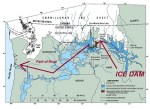
If you go up on Mary’s Peak, located in the central part of western Oregon, you can look out over vast parts of the Willamette Valley.  You will see a place shaped mostly by the meandering Willamette River.  However, every once in a while you will see mounds–big, round mounds.  For a long time it was thought that these mounds were formed by Native Americans depositing shells or dirt for burial grounds.   In the 1920s scientists started to investigate the possibility that a great flood had occurred in Cascadia.  The flood, called the Missoula Wash or Missoula Flood, occurred thousands of years ago when a great glacial lake near Missoula, Montana, burst its seams.   Imagine a wall of water 300 hundred feet tall surging down the Columbia Gorge and then into the Willamette Valley.  What a sight that must have been! This was not one event: the glacial lake burst about every 50 years and made for some really exciting times in the valleys of Oregon and Washington. These floods deposited sand, gravel, and other mineral deposits throughout the area, and left large boulders throughout the Willamette Valley. 

After each ice dam rupture, the waters of the lake would rush down through the Columbia River gorge of eastern Washington and the Willamette Valley of Western Oregon. It took 40 to 50 years for restoration of these areas. Geologists estimate that floods occurred approximately 40 times over a 2,000 year period roughly 15,000 to 13,000 years ago.

Up until about 100 years ago, many of the valley areas of western Washington and Oregon were a series of lakes and marshes.  Anglo pioneers drained and filled in many of the lakes and marshes to create the farmland that is in the valleys today.  Many valuable plant communities were driven to the edges of the valley, and some plants can no longer be found in the area.  Camas, a staple food for native peoples, once graced the old marshlands.  There are few of these plants to be found in the marshes and sloughs of Willamette Valley (including Portland) today. Now many of the area’s camas plants live in very polluted waters. Native peoples did not live year-round in these valleys, because they could have caught malaria or tuberculosis.  They did, however, build seasonal shelters from plants, so they could fish and collect valuable foods and healing plants.

The Coast Range Mountains

The Coast Range Mountains extend from British Columbia to northern California.  The mountains are old and worn away by erosion and time.  They were formed by forces that pushed land up off the ocean floor, and it is not uncommon to find sea fossils and other sea sediments in this mountain range.  Up until about 75 years ago, the area was a vast and beautiful rain forest.  Much of the Coast Range has been clear-cut in the Cascadian bioregion. Many wonderful plants have been lost, because the fragile soils have been washed away by erosion and lack of a supportive ecosystem. Because the soils are old, they lack certain essential minerals needed by plant communities. Many humans who live in these mountains often have bad teeth because of lack of minerals.  Farmers and gardeners must add minerals (glacial rock is a wonderful source of these minerals) to help plants grow.  In the past the forests were kept healthy because of migrating salmon, steelhead, and other sea-run fish.  The spawning fish would swim up the streams, die in the river bed, and provide excellent fertilizer for the forest floor.  The sea -run fish helped plants to thrive.  It is getting harder and harder to find certain very valuable plants that once flourished in the Coast Range, because the fish are disappearing from the streams.

The Coast Range Mountains are not particularly tall compared to the Cascades Mountains, but there are a few larger mountains spattered along the Coast Range. And their height is important, because the taller Coast Range Mountains provide habitat for plants normally found only in the western slopes of the Cascades.

Some of the more important Coast Range Mountains habitats  are found at  Mount Olympus on the Olympic Peninsula, Mary’s Peak (Tamanawis) near Corvallis, Oregon, Mount Ashland near Ashland, Oregon, the Siskiyou Mountains and the Klamath Mountains in southern Oregon,  and the Trinity Mountains of northern California.

The lost world

One of the most important and unique places in the Cascadian Coast Range is the Kalmiopsis Wilderness Area.  There is no other place in Cascadia where you find more diverse, unusual, and important healing plants.  Walking through this area will make you feel like you are visiting another planet.  Even the soil is different. Much of the soil is of the Serpentine type. The hard bluish rock soil often found near perioditite rocks organizes itself in layers and is rich in heavy metals such as magnesium, iron, chromium and nickel, which in high amounts, can be toxic to most plants.  Plants and animals found in this area of Southern Oregon are often unique to the area.  And many of the trees and plants in the area need periodic fire to complete their life cycles.

The Cascade Mountains

Highly volcanic and very alive, these mountains provide much drama for both plants and humans. The Cascades are part of the Pacific Ring-of-Fire, the volcanoes and associated mountains that circle the Pacific Ocean. All of the known historic eruptions in the contiguous United States have been from Cascade volcanoesThey are large and snowcapped in the winter, and some still support glaciers.  In the summer melting glaciers and snowmelt create the beautiful lakes, rivers and marshes of the region. The snowmelt is also the main source for drinking water in the region. The wilderness around these mountains provides a safe harbor for the diverse plant communities that have offered food, clothing, healing, and shelter to humans and other creatures for thousands of years. Each mountain has its own energy but shares with other Cascade mountains similar soils, weather, and plant communities. 

This essay was originally written for Portland Indymedia as a skillshare on January 27, 2008. 

After spending a wet morning in the Oregon Coast range mountains collecting chanterelle mushrooms I decided to sauté up some delicious “roots and shrooms”.

This week I went to a local farmers market and purchased some late season zucchini and some beautiful multicolored carrots.  I also purchased some fresh leeks.  I decided to mix them with my newly found Chanterelles and create a beautiful feast.

The trick to eating mushrooms is to never eat them raw.  Mushrooms have amazing nutritional and medicinal qualities that can only be released through cooking.  Cook all mushrooms at least 15 minutes over low heat.  Here is my recipe for cooking wild Chanterelles.

What you will need:

Two tablespoons olive oil

Two large gloves fresh garlic – sliced thinly

Sliced leeks to taste (I used about ¼ cup)

1 cup sliced fresh carrots

½ cup sliced fresh zucchini

8 to 9 medium to large Chanterelle mushrooms

¼ cup Tamari

Herbs to taste (powered basil, sage, black pepper, and coriander) ¼ teaspoon each

Use a large flat frying pan or a Wok. Slowly sauté two tablespoons of olive oil and two large gloves of fresh garlic on very low heat.  Cook 5 minutes.  Add two tablespoons of tamari, ¼ teaspoon each powered sage, basil, black pepper, and coriander. (You can substitute the herbs you like to use here).  You have now created a wonderful broth to cook your veggies and mushrooms in. Arrange the vegetables and mushrooms on the bottom of a flat surface of the pan in the sauce you have just prepared.

Sauté for at least 15 minutes until the carrots are soft enough to eat. Turn the mixture over a couple of times to make sure all sides are fully cooked. I covered the pan with a lid during this time.  ENJOY!

Chanterelles at Yachats

For the last 2 months I have been engaged in learning everything I can about the fungi that grows in Cascadia.  Why I am writing about this on a blog that is trying to support our reconnection with native plants?  The reason my dear friends is that you cannot learn the life cycles of native plants without understanding the fungi, especially the Mycelium.

For instance, last year I sat upon a journey to try and find and photograph wild orchids in the coastal areas and coastal mountains of Cascadia.  It was not an easy task.  Many of the orchids such as the Fairyslipper (Calypso bulbosa), Mountain Lady slipper (Cypripedium montanum), Western Coralroot (Corallorhiza maculata ssp. Mertensiana) and the Slender Bog Orchid (Platanthera stricta) grow in very fragile areas of our ecosystem.  One indication that an ecosystem is healthy is that the mycelium is unbroken and produces a plethora of fungi.  From spring to fall each year there should be lots and lots of fungi, edible and otherwise available in the forest.

Some orchids will only grow where the Mycelium is intact.  That means there must be old growth trees, few logging roads, and especially there can be no clear cuts. Mycelium provides water and nutrients that keep the forest alive.

So I began my two month long cram session on fungi.  I attended the Yachats Mushroom Fest held in Yachats, Oregon.  I also attended an overnight fungi workshop held at Drift Creek Camp near Lincoln City, Oregon.  The workshop was sponsored by the Friends of Straub Environmental Learning Center in Salem, Oregon.

The Yachats Mushroom fest was three days long and wonderfully educational.  I am a amateur naturalist, a native plant lover without much training in biology or botany.  And, whatever training I attend cannot be too intellectual.  I need teachers who will speak in the language of the naturalist, not the scientist.  But I need the science to be able to fully emerge myself in helping the save these amazing native plants. I was pleasanly surprized at the level of education. I not only understood, but my passion for wild nature was strengthened.  In Yachats we attended two workshops and a mushroom collecting and identifying walk in which the instructors could speak both languages.  One of the workshops was all about the nutritional value of edible mushrooms and also how to cook  and store them.  I learned that there are between 3500 and 4000 varieties of mushrooms and fungi in the Cascadian bioregion.  I learned that many are both nutritional and medicinal and much of the world uses these fungi for healing, nutrition and utility. The cooks made delicious pizza and pâté made from wild Chanterelles mushrooms.

The overnight event organized by the Friends of Straub Environmental Learning center and held at Drift Creek camp was well organized.  We spent two hours in lecture learning about the ecology and identification of mushrooms. Our instructor was Jake Hurlbert, who also taught at the Yachats Mushroom fest was exceptional. Jake is the educational mycologist for the Pacific Northwest Mycological Association and also belongs to the Lincoln County Mycologial society. Presently Jake is conducting a 7-year study of the ecology of fungi and plants of Oregon.

 Did you know that fungi evolved from the same genome as animals?  Now isn’t that strange.  We are closer to fungi than plants genetically!   Jake sent all participants out into the forest for three hours and told us to collect whatever we found.  He then had us bring all the specimens back and he spent another two hours identifying them and taught us about the ecology of these fungi.  Then we had a nice dinner of wild mushroom lasagna and spent a cozy rainy night in a great lodge.

If you would like to know about about fungi – find out if there is a local Mushroom (mycological) society near you.  Here is a link to a website (Puget Sound Mycological Society) that lists many of the mushroom societies in Cascadia. My favorite of course is the Lincoln County Mycological Society.  After all these rains, we should a really nice crop of Chanterelles available.  Happy Mushrooming!

Who came first?

“Animals are something invented by plants to move seeds around. An extremely yang solution to a peculiar problem which they faced.”
-Terence McKenna

Oregon White Oak

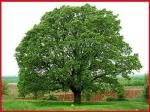
THE OREGON WHITE OAK (Quercus garryana)

When I look across the skyline I still see the White Oak. These trees have been here in Cascadia for thousands of years. The acorns of the White Oak were an important food source for native peoples. Where ever you find these trees you will also find a vast ecosystem of food, healing plants and pronounced animal, insect and plant communities. For instance, if you look up into the branches of the White Oak in the fall and winter you will see mistletoe, at its base you will find small herbs, sweet flowered ground covers, and sumac (also known as poison oak).

When European settlers first arrived in Cascadia they found most of the valley’s of Western Oregon and Washington filled with White Oak forests. The trees are found on dry, rocky slopes of bluffs sometimes on deep rich, well-drained soil and low elevations. As you head south from Eugene, the species of oak trees are slightly different and they are named “Black Oak”.

The White Oak tree is recognizable by is deeply round-lobed oak leaves and it’s light grey bark, with thick furrows and ridges. The tree can grow to be 100 feet or taller.

The acorns of the White Oak were eaten by the local First peoples such as Salish and Kalapuyan, Chehalis, and Nisqually peoples. They harvested the acorns, soaked them to remove the bitter tannin, and pulverized them into a type of flour. These acorns were easy to store through the winter and were not prone to spoilage by mold, moisture or cold. The food from the acorn mash was high in proteins, carbohydrates and nutrients.The Chehalis roasted the oak acorn on a fire. Some first peoples buried the nuts in baskets in the mud of sloughs all winter and ate them in the spring. (Gunther 1945)  All acorns contain large amounts of protein, carbohydrates and fats, as well as the minerals calcium, phosphorus and potassium, and the vitamin niacin. Total food energy in an acorn also varies by species, but all compare well with other wild foods and with other nuts. (Wikipedia: acorns). It is important to remove tannins by soaking overnight in water. Since tannins, which are plant polyphenols, interfere with an animal’s ability to metabolize protein, it is important to remove them before consuming the acorn.

The First Peoples of Cascadia had many uses for oak including making combs, digging sticks and used as fuel.(Turner 1979). And of course, mistletoe is found in the branches of oak.

The bark of the White Oak was one of the ingredients in the Saanich  and Cowlitz “4 barks” medicine used against tuberculosis and other ailments (Turner and Hebda 1990).

Creatures that make acorns an important part of their diet include birds, such as jays, pigeons, some ducks and several species of woodpeckers. Small mammals that feed on acorns include mice, squirrels and several other rodents. Such large mammals as bears, and deer also consume large amounts of acorns: they may constitute up to 25% of the diet of deer in the autumn.

If you live in Portland, there is a beautiful specimen of the White Oak in a park near People’s co-op off of Powell street and 22nd avenue. Go sit under this tree and prepare to be taught. It is the mother of many trees in Portland. I found true grounding under this tree.

References

Gunther, Erna (1945) Ethnobotany of Western Washington: The knowledge and use of indigenous plants by Native Americans,University of Washington Press.

Turner, Nancy J.(1979) Plants in British Columbia Indian Technology, British Columbia Provincial Museum Press, Victoria, Canada

Turner, N.J. and R.J. Hebda. (1990)  Contemporary use of bark for medicine by two Salishan native elders of southeast Vancouver Island. Journal of Ethnopharmacology 229: 59-72
“respiratory ailments were treated with bark of Abies grandis, Arbutus menziesii, Cornus nuttallii, Prunus emarginata, Pseudotsuga menziesii and Quercus garryana;”

Oregon White Oak

Plants as Teachers

If you are looking for a good teacher for learning about plants, look to the plants themselves. All knowledge that would lead us to live rightly on the Earth can be found in its plants.  You only need to possess excellent powers of observation and do what the plants ask you to do. If you know and understand the plant teachers, you will never be hungry, unsheltered, or unclothed. You will surely be a person who lives a prosperous, abundant life.

You have only to go outside and look about you.  If you spend enough time observing the plants, you will learn that they live in systemic communities.  Each plant lives in its own network of fellow plants that provide support and help attract nutrients and pollinators. Humans could learn from these communities, but many humans hold themselves above or apart from nature.

While you are outside, look out to the horizon if you can, and take note of the most prominent plant. Perhaps you see a giant white oak, which was once plentiful and extremely valuable to human survival for thousands of years in Cascadia.  If you live in the forest and cannot see the horizon, look up.  You will see the teacher trees, the mother plants, and their surrounding network of supporting plants. When humans slice away this support through such practices as clear-cutting, slash-and-burn procedures, and use of chemical herbicides, they put plant communities and other biological communities at risk. We must remember that we are all connected; we must hold each other up.

Plants have not forgotten that we are all part of the same community.  When we enter a plant community, the plants will try to heal us and restore us and bring us to a state of balance. What we need to learn is how to recognize  the healing that is occurring and give it support through our actions and the way we care for our bodies and minds.

In research conducted by entomologists Karban and Baldwin of the Wageningen Agricultural University in the Netherlands, plants were found not to be passive organisms at all.  The research challenged the human idea that because plants are firmly rooted in the soil and cannot run away from their enemies, they have long been considered passive in interactions with other organisms.

After decades of research on plant pathogen and plant herbivore interactions, the scientists found that plants take an active role in adapting to adverse conditions.” (Induced Responses to Herbivory  [page 83]).

One of my favorite passages in Stephen Harrod Buhner’s book, The Lost Language of Plants: The Ecological Importance of Plant Medicines to Life on Earth is a story about the interaction between deer and plants in a meadow.

Harrod Buhner writes about researchers asking the question, why don’t deer eat meadow plants down to the root when grazing? The researchers watched a meadow for several seasons, taking all sorts of samples.  In the end they found that the plants themselves control the deer, sending off an aroma and plant chemistry that signal the deer to eat, and then, when the deer have eaten just to the tops of the stems, emitting a bitter chemical that causes the deer to stop eating.  Both plant and deer are healthier for the grazing: the plant receives a good trimming that allows it to build better plant structure, and the deer receives nutrients.  What is most amazing in this story is that the plant is able to switch its chemical output almost instantaneously.

Now if all this is true, why would you, a human, be surprised that when you enter a forest, the plants want to bring you to a state of balance in their community?

Plants teach and compel and push us to return to our true nature and our place in the surrounding community.  When we walk in the forest and we are covered by synthetic chemical smells–smells of plastic and petro and synthetic hormones and medicines–the plants will rain down upon us a curtain of plant substance chemicals. The plants will clean the air and water for us and try to reconnect us to the earth. The community we belong to is connected to all living and nonliving things on this planet. Until we find our way back to living balanced and harmoniously within the tapestry of life, we will continue to feel disconnected and dis-eased. Don’t believe me?  Go into the forest and find a Western red cedar. Sit under the tree for an hour and see how you feel.  You will not only feel changed biologically and psychologically, you will feel connected to the place.

Original post to Portland Indymedia on January 19, 2008 – you can view original with comments at this link


Illuminating thought

“The ultimate role of ethnobotany lies not in the identification of new natural products for the benefit of the modern world, but rather in the illumination of a profoundly different way of living in relationship to nature.” -Wade Davis

                         Who is Wade Davis?  Follow the link

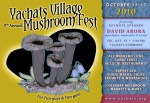
It’s that time of year again!  The Yachats Village Mushroom Fest.  OCTOBER 15-17, 2010  – It cost $5 for the weekend.  The meals are extra and keynote speaker cost extra.  I went last year and it was so much fun and very informative.  The speakers and mushroom identification events were superb!  Take a walk on the wild side.  Connect with the fungi!

 Again, I attended last years event and the speakers were very informative.  Yachats is located on the Oregon coast just south of Waldport, Oregon.  A beautiful drive this time of year.  I learned a great deal about fungi found in the Cascadia bioregion.  There are actually hundreds of fungi that are edible and medicinal located in our forests and valleys.  First peoples and settlers used some of the fungi for utility too.  The fungi was used for Bowls, shoe soles, bags etc.  We were taught how to cook and yes…we did eat some of these delectable forest specimens. The fungi are high in protein and other nutrients. The medicinal value are amazing.  The far east has used mushrooms for healing non-stop for thousands of years.

  Every hour a bus would come and pick us up and take us into the forest for a FREE walking lectures.  We learned how to identify the mushrooms and learned about the forest ecosystem that supports and thrives on this important fungi.

Also during the day are many workshops.  Check out the link for a full schedule.  From mushroom identification, to cooking and using mushrooms for fiber dye…check out the schedule.

This year the keynote speaker is DAVID ARORA Acclaimed mushroom expert and author of Mushrooms Demystified  and All That The Rain Promises & More will deliver the festival’s opening night keynote address. Friday, October 15 at 7:00 PM.  Admission $12, $8 students.  He will also be offering a full-day workshop on Sunday as well. 

Get out of your house!  Get away from the computer.  Go to the coast and have a really wonderful time learning about the bounty of the ecosystem we live in.

Here is a link to their website:  The Yachats  Mushroom Fest